Thursday, 28 January 2016

William Labov


William Labov


Labov's Background


Labov was born in Rutherford, New Jersey on December 4th 1927, he studied at Harvard University and began work as an industrial chemist before turning to sociolinguistics. In 1963 he completed a study of change in the dialect of Martha's Vineyard, which was presented before the Linguistic Society of America. Labov took his PhD in 1964 at Columbia University and taught at Columbia before becoming a professor of linguistics at the University of Pennsylvania and then became director of the university's Linguistics Laboratory in 1977. He has been married to fellow sociolinguist Gillian Sankoff since 1993. Prior to his marriage to Sankoff, he was married to sociologist Teresa Gnasso Labov.


Labov's two most famous studies are the Martha's vineyard study and the department store study 


Martha's vineyard study(1960)


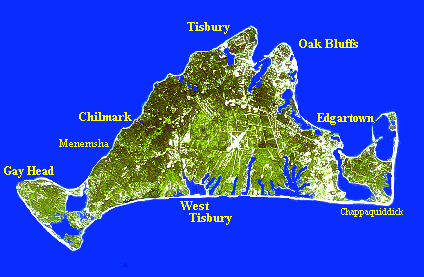
On Martha's Vineyard a small group of fishermen began to exaggerate a tendency already existing in their speech. They did this seemingly subconsciously, in order to establish themselves as an independent social group with superior status to the despised summer visitors known in the study as "summer people". A number of other islanders regarded this group as one which epitomised old virtues and desirable values, and subconsciously imitated the way its members talked. For these people, the new pronunciation was an innovation. As more and more people came to speak in the same way, the innovation gradually became the norm for those living on the island. Labov studied the way in which this language evolved specifically with the use of diphthongs (double vowel sounds such as 'oil' and 'mouse').


The department store study (1966)


The speech of sales assistants in three Manhattan stores was studied by Labov, drawn from the top (Saks), middle (Macy's) and bottom (Klein's) of the price and fashion scale. A customer assistant in each store was approached with a factual enquiry designed to elicit the answer - "Fourth floor" (such as "where can I find the shoes") - He recorded whether the post vocalic /r/ sound in the answer was strongly pronounced i.e ("forrth floorrr" as oppose to "fouth flur"). He pretended not to have heard so he could obtain a repeat performance in careful, emphatic style. The findings were that the sales assistants from Saks used it most, those from Klein's used it least and those from Macy's showed the greatest upward shift when they were asked to repeat.
The results from the department store study highlight the main themes of the research. Frequency of use of the prestige variable final or post vocalic (r) varied with level of formality and social class


Labov still works at Philadelphia University as a professor at the age of 88.

Useful links
 
contact Labov
Linguistics Laboratory 
3810 Walnut St. 
Philadelphia, PA 19104
(215) 898-4912
(215) 573-2427

Labov Timeline


Monday, 18 January 2016

Geordie accent case study

geordies appear to have rich and varied regional dialect. Some words almost appear as if they're from a diferent language, this is because invasions into England meant that the North East was linguistically isolated therethe dialect has evolved differently in the following 1500 years.

A few words which are paticulalry different include:

'Marra' meaning mate

and

'spelk' meaning splinter

The word Geordie refers to Natives of Newcastle-upon-Tyne.

There are several theories about how the word 'Geordie' was derived but they will be quick to tell you that their accent and dialect is very different from the surrounding 'Pitmatic' or 'Makeem'

It is believed that the Geordie accent isn't just conquering dialect levelling but also spreading; I believe this to be due to the media, popular T.V shows such as Geordie Shore show the Geordie dialect as more cool and popular with young people, this creates divergence and also changes attitudes towards the accent.

I believe older people watching a show in which young Geordies act perhaps foolishly and irresponsibly will associate the accent with low intelligence, and due to the cheating and lying in the show, particularly un-trustworthy. However, they might associate it with more friendliness because of their up-beat nature   

Thursday, 14 January 2016

assessment feedback


Assessment feedback

A01 – out of 10

  • Written expression- ability to communicate in clear topics and paragraphs
  • Use language terminology- lexis and grammar

A02 – out of 20

  • Language concepts and issues
  • Own examples
  • Stereotypes
  • Representation

How to get marks

A01:

  •  Clear topic sentence
  • Worthwhile introduction/conclusion
  • Linguistic terminology
  • Women use tag questions, intensifiers…
  • Men use more imperatives
  • Women use more modal verbs

A02

  • Discussion and link to theories
  • Does data reinforce or contradict?
  • Be tentative
  • It doesn’t prove a theory wrong- it just contradicts it
  • Discuss or challenge theories if appropriate
  • Don’t say Lakoff is wrong
  • 3 D’s- make sure you know who did what!
  • Consider other contextual factors of the data
  • There are other factors other than gender, such as occupation…
  • Consider written as well as spoken interaction
  • Discuss stereotypes, how do you think men and women are told how to behave
  • Status vs support  this is where you can link to Cameron
  • Show own research

Improvement paragraph  

The average ‘did interrupt’ was also higher in males (with the exception of ‘woman D’ who had the same as ‘man E’). This suggests that the men used more oppressive discourse strategy to dominate the conversation. It also supports Tannen’s ‘order vs proposals’ idea as men use more oppressive declaratives to make themselves heard more and stand out as a somewhat ‘alpha male’. Whereas women would be more likely to wait their turn in speech then use more verbose language in accordance with Lakoff’s deficit theory                                     Universalteacher.org  

  •   
Basics of noun


common


abstract- lass clear things - emotions


group- a collective like a group such as a flock, family etc


concrete- something that can be perceived
              - can be divided into countable or non-countable


Proper 


unique things, names of cities, companies etc...


Abstract nouns can be easily confused with adjectives
- anxious vs anxiety


Dictionary- concrete
despair- abstract
herd- group
joy- abstract
sellotape- proper

Thursday, 10 December 2015

Bristolian accent and dialect case study


  • It is believed that the proud, identifying 'farmer-esc' Bristolian dialect is in fact being levelled despite the attempts of people such as Terry the odd job man to save and spread the dialect. He see's it as his duty to spread the dialect so people can understand and embrace it more. Despite his attempts majority public opinion is that the dialect is being levelled, this is shown through what's said in the Bristolian Linguistic diversity section of the full English website, Jessica Luce makes relevant comments with regards to the idea that the dialect is being diluted by students coming into Bristol and proudly expressing their own identity, despite this the accent itself is not being diluted.


stereotypes associated with the Bristolian accent are: 


  • Farmer
  • pirate
  • uneducated
  • predominantly male
There is much debate about how Bristolian words such as 'gert' (gurt) should be spelt, this is expressed through the beast clothing t-shirts which express the Bristolian dialect through their popular t-shirt brand.

A common stereo-type associated with the Bristolian dialect is that of Vicky Pollard, the 'Little Britain' character, the common Bristolian opinion of her character is one of annoyance due to the mild discrimination many Bristolian's get from outsiders. Because of the 'yeah...but...no...but' was decided against as a t- shirt idea for beast clothing

Thursday, 3 December 2015

Analysis of Letters

The two letters, despite having the same intention, are written in ways which contrast greatly.

The converging letter is writen in a more conservative tone, as shown by introducing the letter with 'regret to inform'. This is a way of non-directly saying that something bad has occured and preventing the use of a face-threatening act. The diverging letter, however, starts with 'I am extremely pissed off...'. This is a very direct, taboo introductory sentence and will most certainly come across as a face threatening act. 

The converging letter is an example of the influential power that teachers have over the parents of there students. This is shown through the tone created by the language used by the teacher, the way the text is written in preverbial 'peaks and troughs' displaying a negative being covered up by a positive. This is shown through 'a shame consindering his incredible achievments prior to the academic year'. this is a way implementing power in a more influential respectable way.

Again, this is contrasted by by the the continual negativity shown in the diverging letter, in this text the teacher is trying to implement instrumental power which is a more forceful way of gaining respect and is used a lot less freguently and virtually never in this context.

Thursday, 26 November 2015

Converging letter

Dear Mr and Mrs ****

I regret to inform you that your son is not performing to what I believe is the best of his ability. This is such a shame considering his incredible achievments prior to this academic year. I must ask that you as a parent will talk to him about the effort he is putting into his schooling so we, as a team can help him to achieve his potential.

Kind regards
Joseph Cruse


diverging letter

Dear Mr and Mrs ****

I am extremely pissed off with your son! I have have never been treated with so much disrespect and at times the though of smashing his head through the classroom window has been more than just apparent in my sub-conscious, how you could've brought your son up this way is thoroughly above me and if you dont attempt to sort out this excuse for a boy I swear I will violently take matters into my own hands. I've had enough of all your son's shit so I leave you with this as ultimatum; you sort him...or I do.
Fuck you.